home | tech | search | checkout | contact | email | forum   


Classic Inlines
603 W Pecos Ave
Mesa, AZ 85210
(602) 708-6650


Selecting the Right Carburetor

Choosing the right carburetor is critical if you want to achieve the maximum power potential of your inline six, as such it's one of the most important decisions you'll make. Selecting the wrong carburetor, to big or to small, decreases power and driveability. An improperly sized carb may also result in hesitations and/or flat spots, poor idle quality, reduced mileage, and increased emissions. The most common mistake when building a performance motor, V8 or Inline, is selecting a carb which is simply to big (or oversizing the carb). Don't fall into this trap, bigger is not better.......

The idea is to choose a carburetor that has a large enough bore and venturi to allow maximum airflow, yet one that's small enough to maintain a high-speed airflow signal through the primary venturi(s), which the carburetor reads in order to determine how much fuel is required to achieve the proper air/fuel mixture. Lets say that again..... The idea is to choose a carburetor that has a large enough bore and venturi to allow maximum airflow, yet small enough to maintain a high-speed airflow signal through the primary venturi(s), which the carburetor reads in order to determine how much fuel is required to achieve the proper air/fuel mixture.

In theory, if the bore and venturi are too large, the signal will be weak at low engine speeds. As such, fuel will not be pulled from the carburetor's discharge ports accurately and the air/fuel mixture will be lean. The opposite of this effect, is when the carburetor's bore and venturi are too small for the engine's airflow demands. While throttle response will be outstanding, the engine's maximum power potential will be diminished. The ideal carburetor will move the maximum amount of airflow through the carburetor and intake manifold, while maintaining the strongest possible signal. This was very evident when we spent a day at Pony Carbs, testing various carbs on a small six (see the tech article on our dyno results).

It's important to use a CFM calculator to select the proper size carburetor for your CFM requirements. However, the calculated results are just that, calculated. Once you have done the calculations, consider the following "Rules of Thumb" before you make your final decision. For street motors, its better to start with a smaller carb, for more torque. On the other hand, it's preferable to use a bigger carb for race applications, which give you maximum power at wide open throttle. Street/strip motors require a carb sized somewhere in-between.

Rules of Thumb
Bigger Carb
Smaller Carb
Results in More Horsepower
Results in More Torque
Results in a Higher RPM Range
Results in a Lower RPM Range
Prefers Higher Compression Ratios
OK with Lower Compression Ratios
Best with Higher Rear Gear Ratios
Best with Lower Rear Gear Ratios
Likes More Cam Duration
Good with Less Cam Duration
Better with Manual Transmissions
Better with Automatic Transmissions
Better with High Stall Converter
Better with Low Stall Converter
Needs More Mechanical Adv.
Needs Less Mechanical Adv.

Volumetric Efficiency must also be figured in to your CFM calculations. A stock early log head, with a 1-7/16 carb bore (small log), will normally see about 65% efficiency do to the restrictive nature of the log intake. While a fully ported aluminum head can reach 100%. Turbo charging the log head will net huge improvements in the efficiency, as the short comings of the asthmatic log manifold are greatly diminished.

In the chart below, we have done the CFM and VE calculations for a daily driver or weekend cruiser. If you're building a race motor, increase the size by 50-100 CFM, as the motor will require more airflow when operating in the higher RPM ranges. It's easy to see how the CFM requirements change, based on the various modifications.

Block
Cylinder Head
Modifications
200ci
250ci
Stock Motor
Early Small Log
Stock valves
200-210
255-265
Mild Build
Early Small Log
Large valves
240-250
300-310
Performance
Early Small Log
Port & Polish
275-300
325-335
Stock Motor
Late Large Log
Stock valves
220-245
295-320
Mild Build
Late Large Log
Large valves
255-280
325-350
Performance
Late Large Log
Port & Polish
295-320
375-400
Stock Motor
Converted Log
Stock valves
235-260
295-320
Mild Build
Converted Log
Large valves
275-300
345-380
Performance
Converted Log
Port & Polish
315-340
395-420
Stock Motor
OZ-250-2V
Stock valves
250-275
315-340
Mild Build
OZ-250-2V
Large valves
290-315
365-390
Performance
OZ-250-2V
Port & Polish
335-360
420-445
Stock Motor
Aluminum
Stock valves
285-310
355-380
Mild Build
Aluminum
Large valves
330-355
410-435
Performance
Aluminum
Port & Polish
375-400
475-500
Stock build: 5500 rpm - Mild build: 6000 rpm - Performance: 6500 rpm

Once you've determined your CFM requirements, the next step is to select a carburetor. The biggest decision is whether to use a one barrel (1V) or upgrade to a two barrel (2V). With all the different carburetors that are available, this may be very confusing, but its really pretty simple and straight forward.

Ignition Concerns

The other thing you need to think about when doing a carb swap, is the ignition system. If you have an Autolite 1100-1V carb, you may need to swap out the distributor as well. The early (63-67) 1100's came with a Spark Control Valve and were designed to work hand in hand with the stock Load-O-Matic distributor. If you swap to a carb that doesn't have the Spark Control Valve, you'll need to swap the distributor as well. And while the later (68-69) 1100's didn't have a Spark Control Valve, the stock distributors operated on mechanical advance only. Lacking vacuum advance, these distributors offered poor performance and should be swapped out with a distributor that has provisions for ported vacuum advance. If you swap over to a 2V carburetor, you'll definitely need to ditch the stock distributor and install a Duraspark, DUI, or other aftermarket distributor.

CAUTION: For more information, please read our tech article on the Load-O-Matic distributor and how it works hand in hand with the Autolite 1100-1V carb. Before you swap carburetors, it is essential to understand the differences between the various distributors and how these differences relate to selecting the right carburetor.

Autolite 1100 carb with a "Spark Control Valve" (circled)

One Barrel Carbs

First, lets go over your carb choices for a one barrel. In the early years Ford used Holley-1904-1908-1909 carburetors from '60-63, and the more common Autolite 1100 from '63-68. All of these carbs had 1-7/16 inch carb bores. The Autolite 1100's were offered on the 170 and 200ci, with three venturi sizes (1.00/1.10/1.20). Mustangs had the 1.10 or 1.20 inch depending on model year and configuration. In '68-69 they switched to the larger Autolite 1101's, and/or Carter YF carbs. The YF's first saw use on some California 170/200ci sixes in '67 to lower emissions. From '70-73 they used the more common Carter RBS, which came on the 250ci engine. The 1101, YF, and RBS carburetors had 1-11/16 inch carb bores.

The Autolite 1100's are fine for stock applications, but they obviously come up short in the performance arena. Many inline enthusiast prefer upgrading the early log heads and smaller Autolite or Holley carburetors to a late model cylinder head with the larger Carter-YF and RBS carbs. While this will increase the engines power output, most of the additional power is the direct result of the of the late model cylinder head, with it's larger valves and increased manifold volume, rather than the carburetor. However the larger carburetor, which increases CFM, certainly doesn't hurt.

We've all heard that Autolite carbs are considered to be the best carbs ever built. However the Autolite 1100's were designed and built before Annular Fuel Discharge technology was incorporated into the carbs. As such, the Autolite 1100's don't measure up or perform nearly as well as their bigger brothers (2100/4100 series carbs), which incorporate annular boosters. The early Autolite 1100's (63-67) also used a Spark Control Valve (SCV), which was designed to work hand in hand with the Load-O-Matic (LOM) distributor. However, the later 1100's (68-69) were designed without a Spark Control Valve, allowing Ford to ditch the Load-O-Matic distributors in favor of the Duraspark distributor. Please read our tech article on the Load-O-Matic distributor for more information. It's important to know how they operate, especially if you plan to do a carb swap.

Another option for a 1V carb is the new "Vaporizer" carburetor, which was introduced by Pony Carbs in 2008. Basically the Vaporizer is an Autolite 1100, however it has been redesigned to incorporate Annular Fuel Discharge. This gives the new Vaporizer superior performance, drivability, and mileage, over the old 1100 series carb. The Vaporizer is rated at 200CFM and is offered with or without the Spark Control Valve. It also comes with an automatic (hot air) choke and an optional extra long header choke tube, which is needed if you've installed aftermarket headers. The hollow aluminum tube clamps to the outside of the header with a hose clamp, which provides hot air to the automatic choke.

For stock applications or mild performance engines, the Vaporizer is an excellent choice and tough to beat. Not only will you realize an increase in horsepower, you should also see small gains in your gas mileage. Both are a result of the Annular Fuel Discharge boosters, which atomize the fuel better than the older carbs ever dreamed of doing, especially at idle and lower rpm's. Dyno test have shown the Vaporizer to increase power by as much as 20HP, however for most applications one should expect to see gains around 10-15 HP. As in stock applications, the Vaporizers are available with, or without the Spark Control Valve.

As we said earlier, the stock Load-O-Matic distributor is designed to work with carburetors that have a Spark Control Valve. Like the stock Autolite 1100's, the Vaporizer comes with, or without the Spark Control Valve. Therefore, if your planning to keep the stock Load-O-Matic distributor, you'll need to order the early (63-67) version. But if your going to swap out the distributor with a Duraspark or DUI, you'll need to order the late (68-69) version.

NOTE: If you plan to keep the stock Load-O-Matic distributor (with points or a Petronics ignition module), you must use a carburetor that incorporates a Spark Control Valve (SCV) in order for the distributor to function properly. On the other hand if you plan to upgrade your distributor for a more modern one, such as a Mallory, Duraspark, or DUI, then a later model carb (68-69) without a Spark Control Valve (SCV) would be the correct choice.

For those who are restoring their cars, the Vaporizer maintains a stock appearance. Other advantages include the ability to use the existing carb linkage, as well as stock or aftermarket air cleaners. And you don't need to worry about hood clearance either, unlike other applications that use tall carb adaptors. While the Vaporizer seems to be more expensive than other carburetor options, it really isn't. There are no throttle cables to purchase, no linkage to modify, no adaptors to purchase and stack up, and no special gaskets required. You also won't spend hours searching for custom air cleaners to fit under your hood, or to find and modify a gas pedal for the cable throttle. All you need is the Vaporizer, your basic hand tools, and a few minutes to swap the carb and set your timing. It even comes with a DVD that explains how to install it and how to adjust your timing. What could be easier than that? The new Vaporizer carburetors are available from Classic Inlines. We also sell extra long header choke tubes, as well as Duraspark II distributors, and DUI Ignition Systems.

The last option for using one barrel carbs, is to install triple one barrels. This is done by installing a custom manifold produced by Offenhauser, which bolts to the top of the existing log manifold. To maintain low end performance, the setup utilizes progressive linkage. As such, the engine runs on the center carb most of the time, and only kicks in the outer two carbs when their needed. Triple one barrels are also hard to beat if your looking for some eye candy to spruce up your engine bay, however they do come at a price. Triple carbs are difficult to tune and to keep tuned, and as such, they require regular maintenance. Another drawback is that the cylinder head has to be machined to accept the new manifold, and the linkage needs to be modified accordingly. Finally, by the time you purchase the manifold, linkage, carbs, air cleaners, and hardware,this upgrade can get a little on the pricey side.
Two Barrel Carbs

One of the most popular modifications for increasing horse power and performance, is to install a two barrel carburetor on the existing log manifold. This can be accomplished with various adaptors and/or machining and modifying the existing log manifold. Each method has advantages, and disadvantages, so you'll need to know the differences to make the best decision.

The most common mistake when installing a two barrel carburetor, is installing a carb which is simply to large for the application. The engine might actually make less power, and may stumble and fall flat on its face when you push the peddle to the medal. Most DIY, backyard mechanics simply ignore CFM calculations and install the biggest two barrel carb they can get their hands on, thinking they are going to haul ass once it's installed. They couldn't be more wrong, and they are most certainly going to be disappointed in the results.


The most common method of installing a two barrel carb, is by using a 2-1 adaptor. The adaptor merely changes the bolt pattern and bore size of a one barrel carb to a two barrel. They are several different adaptors available, some work with Autolite and Holley carbs, others with progressive Weber's. Carb orientation also varies, depending on the adaptor design. Bottom line, make sure you purchase to right adaptor for your application. Classic Inlines now offers billet adaptors for most applications, and we are working on the ones we don't cover. We are also working on companion phenolic spacers, which will serve two purposes. First, it will funnel the air from two to one, for improved air flow. Secondly the phenolic material provides a thermal barrier to prevent heat soak, which is a common problem on our inlines. With the carb sitting directly over the exhaust manifold or header, heat transfers upward to the carburetor resulting in vapor locks and/or poor performance.

In general, Holley and Autolite carbs don't work well on stock or mildly performance motors, which are intended as daily drivers. In fact, Pony Carbs won't even sell you one of there two barrel carbs if they know it's going on an inline six. However, they will make an exception to this rule, but only if you are using one of our aluminum cylinder heads. In most cases, Holley and Autolite carbs should only be used on motors that have had extensive head work (larger valves, porting, 2V conversions, etc), increase compression ratios, and a performance cams. While they may give you a little more top end power on a stock motor, you can almost certainly expect to see hesitations and flat spots under hard acceleration, at lower rpm's, and off idle. They certainly won't be an out of the box installation, and you'll probably need to play the carb quite a bit (re-jetting), to get it to a point where it is satisfactory. If this is possible.

If you insist on installing a Holley or Autolite carb, via an adaptor, you'll be much better off with an Autolite carb for two reasons. First and foremost, the Autolite's are available in several different sizes, making them much easier to size to your motors specific CFM requirements. We recommend either the 240 or 245 CFM carbs. Secondly, Autolite carbs incorporate Annular Fuel Discharge, which helps to diminish the effects of oversizing the carb. In other words, while you may still have hesitation and flat spots under acceleration, they may not be quite as noticeable. It should be noted that there are kits are available to add annular discharge to Holley carbs, however they may diminish the CFM ratings slightly, as the annular boosters are larger in diameter.

A far better choice for stock or a mild performance motor, would be the progressive Weber, or what some call the Holley/Weber, or 32/36 Weber. The progressive Weber is a two barrel carb, but it differs from Autolite's and Holley carbs, in that the secondary doesn't open until the carb is at 2/3 throttle. The advantage of this is simple. The progressive Weber operates as a one barrel carb most of the time, with the secondary only opening when its needed, under hard acceleration or wide open throttle. This greatly reduces the likely hood of hesitation and/or flat spots under normal operation, and helps to maintain throttle response and improve mileage. However the additional venturi, or secondary, increases the air flow when its needed, giving you better acceleration, improved passing power, and more top end power.

The final method for installing a two barrel carb, is using a special conversion plate, or adaptor. This method requires modifications to the log intake, and as such the cylinder head must be removed and reinstalled after the modifications are completed. But this isn't all bad, as its a great time to install larger valves, new guides and seats, do a little port work, and CC the chambers. This is also a good time to increase the compression ratio, which is accomplished by milling the head and/or installing a thinner head gasket.


The conversion method is by far the best way to install a 2V carb on a log intake manifold. Regardless of which carb you select, the power gains are substantially increased when the log intake is opened up to accommodate a two barrel carb. Classic Inlines did a lot of dyno testing last summer and our results were just as we suspected. Adding a 2V carb via a 2-1 adaptor generally netted 4-5HP, while a converted head bumped the power by 20-25HP. That's a huge difference considering we used the same carbs. The only difference was the method used to mount them. See our tech article for more information.

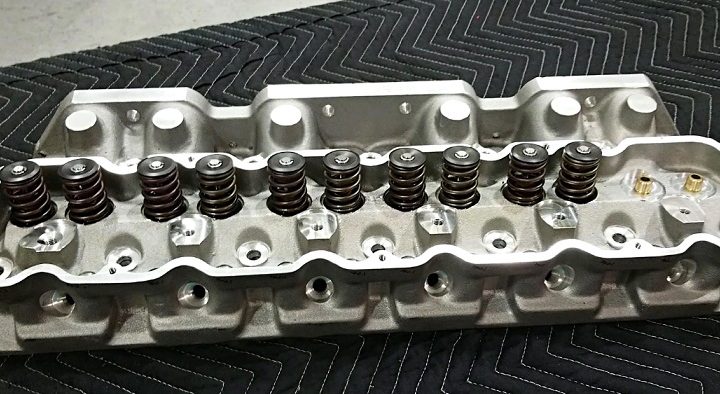
In the near future Classic Inlines will be offering converted heads. Or you can save a core charge by sending us your cylinder head. Classic Inlines offers a wide range of services, including new or oversized valves and valve seats, and/or unleaded valve seats. We can install new freeze plugs, valve guides, valve springs, retainers, and viton seals, plus we do multi-angle valve jobs, back cutting, CCing and reshaping the chambers, 2V conversions, porting and polishing, flow testing, and any other machine work required. We also offer furnace brazing, aluminum and iron welding, and we can repair cracked or damaged cylinder heads. All cylinder heads are cleaned, hot tanked, and magnafluxed before we start work, and pressure tested when the work is completed.

Holley:
Holley offers two sizes, 350cfm and 500cfm, which are available with manual, electric, or hot-air chokes. Both carbs are synchronous, which means both barrels open at the same time. Unfortunately, this also means they are more prone to hesitation and flat spots during quick acceleration, especially if your using a 2V adaptor. Therefore in most cases, the smaller the carb, the better. However if your motor has a performance rebuild and/or a modified cylinder head (2V conversion), the likely hood is greatly reduced or eliminated. It all depends on the CFM requirements of your specific motor. Normally the 350 has better throttle response and low end torque, with less top end power. The 500 offers more top end power, but lower bottom end power, reduced throttle response, and a greater chance for hesitation and flat spots.

Autolite:
Autolite carbs (also synchronous) are available in seven different sizes, making them much easier to size to your motors CFM requirements. Ranging from 240cfm to 351cfm, they are available with manual, electric, or automatic hot-air chokes. For most applications we recommend either the 240 or 245 CFM carbs. Not only can you can select a smaller carb, which is better suited to your CFM requirements, they also incorporate a feature called Annular Fuel Discharge, which greatly reduces the likely hood of hesitation and flat spots under acceleration. For more information on Annular Fuel Discharge, please see our tech article on Autolite Carbs.

It should be noted that kits are available to add annular fuel discharge to Holley carbs, however the larger annular booster slightly diminish the CFM ratings.

Weber/ Holley-Weber:
Weber offers several carbs, in various styles (sidedrafts, downdrafts, etc) and sizes, with manual, electric, or hot water chokes. The most commonly used carb on a small six is the 32/36 DGV, which is a progressive down-draft. A progressive carb operates on the smaller primary venturi most of the time, during light acceleration and cruise. With the larger secondary venturi opening at 2/3 throttle, under hard acceleration or wide open throttle. This improves throttle response and mileage, and greatly reduces the likely-hood of hesitation and flat spots during acceleration, as the secondaries only open when needed.

In the coming months, we will be adding several tech articles on the Weber carbs, simply because very little information is available on the internet.

NOTE: For information on Calculating CFM, please read our tech article.

Summary

Vaporizer 1V
  Advantages
  Incorporates Annular Fuel Discharge, which in itself has numerous advantages.
  Yields the highest power gains possible from a 1V carb, and many 2V applications.
  Allows the use of existing carb linkage and air cleaner. No modifications required.
  Allows use of original distributor (with SCV), or aftermarket dizzy's (without SCV).
  Out of the box install, making it the easiest carb swap. Built for your application.
  Keeps the engine bay looking stock, for a contours appearance. Very clean.
  DisAdvantages
  Quite honestly we couldn't think of any, other than it would limit the power gains of a performance engine which requires more CFM than the Vaporizer can provide.
Offy 3-1V
  Advantages
  Center carb functions as primary, and outer carbs as progressive secondaries.
  Maintains fuel economy, yet provides additional power when needed.
  Offers old school Hot Rod appearance, which is a show stopper. Great eye candy.
  Vacuum secondaries eliminate the likely-hood of hesitations and/or flat spots.
  DisAdvantages
  Requires the removal and reinstallation of the cylinder head.
  Requires machine work and modification to the log intake.
  Requires modification to the throttle linkage.
  Requires continued maintenance to keep carbs in tune.
  Increased return spring pressure may cause leg fatigue on long drives.
Weber 2V
  Advantages
  One venturi functions as primary, other venturi functions as a vacuum secondary.
  Maintains fuel economy, yet provides additional power when needed.
  Allows two barrel carb swap on an otherwise stock motor, without over carbing.
  Vacuum secondary eliminates the likely-hood of hesitations and/or flat spots.
  DisAdvantages
  Requires modification to the throttle linkage.
  May cause hood clearance issues, depending on adaptor height.
  May be difficult to locate parts for tuning and maintenance.
Autolite 2V
  Advantages
  Carbs are available in eight different sizes to meet your specific CFM requirements.
  Incorporates Annular Fuel Discharge, which in itself has numerous advantages.
  Annular discharge reduces hesitation and flat spots, when compared to a Holley 2V.
  DisAdvantages
  Requires modification to the throttle linkage.
  While hesitation and flat spots are reduced, they may still occur under acceleration.
  May cause hood clearance issues, depending on adaptor height.
Holley 2V
  Advantages
  Both sizes are readily available, as are parts for tuning and maintenance.
  Resulted in the highest HP gains, using a 2-1 adaptor, during our dyno testing.
  Cost may be lower due to availability. Easy to find at swap meets, new or used.
  Can be modified to accept Annular Fuel Discharge boosters.
  DisAdvantages
  Only available in 350 and 500 CFM models, which may result in over carbing.
  Hesitation and flat spots are likely under hard or sudden acceleration.
  Requires modification to the throttle linkage.
  May cause hood clearance issues, depending on adaptor height.
Conversion 2V
  Advantages
  Yields the highest power gains possible from a 2V carb.
  Allows the use of any 2V carb, without adaptors.
  Ability to use any aftermarket air cleaner.
  No hood clearance issues.
  Cleanest looking installation.
  DisAdvantages
  Requires the removal and reinstallation of the cylinder head.
  Requires machine work and modification to the log intake.
  Requires modification to the throttle linkage.
 

Of all the 2V upgrades, this is the most difficult and costly. However, that being said, it also offers the greatest gains. Like the old saying says, "You get what you pay for".


Recommendations

If your building a stock or mild performance motor, the Vaporizer can't be beat. This is especially true if your concerned with keeping the motor looking stock, or as close as possible, or if you don't want to modify (temporary or permanent) the existing carb linkage or a numbers matching cylinder head.

If your building a stock or mild performance motor, and you want the added punch of a two barrel carb, the Progressive Weber is the way to go. The only modification required, is to the existing carb linkage, however that's usually pretty simple. A lot of guys just switch over to a throttle cable. The only problem here, is that no one makes a kit, yet.

If your building a performance motor, and can't afford an OZ head or our aluminum head, a late model head with a 2V conversion is the only way to go. The best way to do this, is to purchase a second cylinder head, and work on it as time and money permits. This way you won't be rush and wind up taking short cuts, and you can work on it when your pocket book allows, rather than trying to do it all at once.

If you already have a carb sitting on the shelf, grab a 2-1 adaptor and install the 2V carb on your log head, while your working on your conversion head. The experience you'll gain tuning the carb will be invaluable to you when you go to install the converted head. If you get frustrated tuning the 2V carb, or run out of time, you can always pop the carb and adaptor back off and reinstall the one barrel. Then go back at it when you have more time.

Click here to purchase an Autolite carburetor
Related Tech Articles


Copyright 2010 - Classic Inlines - All Rights Reserved

home ] [ index ] [ products ] [ search ] [ checkout ]